Free · Philippines
Before Boarding a Domestic Ferry: Seven Checks
Product type: Free practical guide and printable checklist
Audience: Independent travellers using a domestic passenger ferry in the Philippines
Fact-check date: 26 October 2026
What this guide solves
“The ferry to the island” is not enough information for a usable travel plan. A Philippine sea journey has an exact departure port, terminal, shipping operator, sailing, vessel or service type, check-in process, baggage rule and weather exposure. Two services described with the same city pair may leave from different places or apply different conditions.
This guide gives you seven checks to complete before you travel to the port. It is deliberately narrower than PH-PF-02 - Flight or Ferry Connection? A Buffer-Time Checklist, which helps compare connection time. Here, the job is to establish that you have the right ticket, the right departure point, the right documents, a current sailing status and a workable backup.
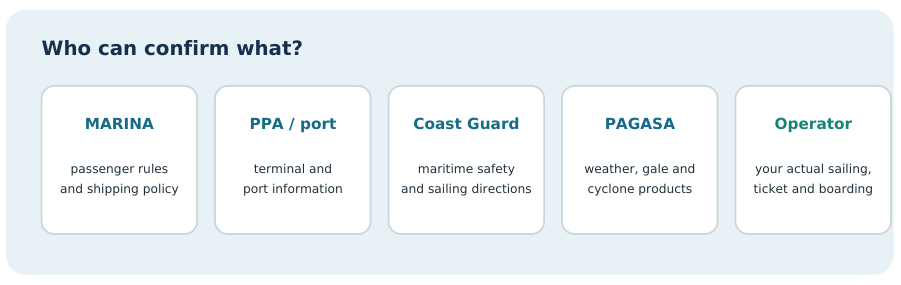
It does not certify a vessel, promise that a sailing will operate, or replace instructions from the Maritime Industry Authority (MARINA), the Philippine Ports Authority (PPA), the Philippine Coast Guard, PAGASA, the port or the shipping operator.
The one-page outcome
By the end, you should be able to write:
We are booked with [operator] on [service/vessel if shown], departing [exact port and terminal] at [date and time]. We will arrive by [time] with [identity and ticket evidence]. The latest official status check is [source and time]. If the sailing changes, our first usable fallback is [plan].
If any blank remains, keep the booking flexible and do not build a high-consequence same-day connection around it.
Check 1 - Name the exact operator, sailing and departure point
Start with the operating company, not the booking site. Record the name shown on the ticket and the name of the company actually operating the service. If a reseller or travel agent issued the ticket, keep that name separately.
Then identify the physical departure point. A city or island name is not a terminal address. Some destinations have several ports, and the port used by one service may not be the port used by another.
Departure identity card
| Field | Your confirmed detail | Evidence and time checked |
|---|---|---|
| Operating company | ||
| Booking seller, if different | ||
| Route shown on ticket | ||
| Sailing date and departure time | ||
| Vessel/service name or number, if provided | ||
| Exact departure port | ||
| Passenger terminal or pier | ||
| Map pin or written address | ||
| Operator contact channel |
Do not copy the address from an old blog or assume that a landmark name is a terminal. Use the operator's current booking message and a current port or terminal source. Ask the operator which entrance a passenger should use when a port complex has several gates.
Stop sign: the ticket says only a city pair, but you cannot identify the operating company and exact terminal.
Check 2 - Protect the ticket and passenger identity
Use an official operator channel or a seller you can independently identify. MARINA announced in April 2026 that its Ships E-ticketing Application System, or SEAS, mandates online ticketing for covered domestic passenger ships and links ticketing with passenger manifests. Implementation details and operator channels can change, so use the current operator instructions rather than assuming that every route has the same purchase process.
MARINA rules also require passengers to be counted and manifested. That is why the name and traveller details attached to the ticket matter. Enter them exactly as required by the operator and carry the identity document the operator says it will accept.
Ticket authenticity check
- The website, app, counter or agent can be tied to the operator.
- The payment recipient matches the expected seller or operator.
- The confirmation contains a booking reference, route, date and passenger name.
- The ticket states how to retrieve or reprint it.
- You know whether a screenshot is accepted or a live app/printed copy is required.
- Every traveller, including a child, appears as required by the operator.
- You have not placed full passport or payment-card details in a shared itinerary.
Evidence pack
Keep these in two places, such as your phone and an offline folder:
- ticket or official confirmation;
- payment receipt;
- operator terms supplied with the booking;
- identification required for boarding;
- any child, senior, student, disability or other fare evidence claimed; and
- the contact channel used if the ticket needs correction.
Stop sign: a social-media message asks you to pay a different personal account or a new link, while the official operator channel does not confirm the change.
Check 3 - Get the current sailing status from two responsible sources
A timetable shows an intended service. It is not proof that the sailing is operating today.
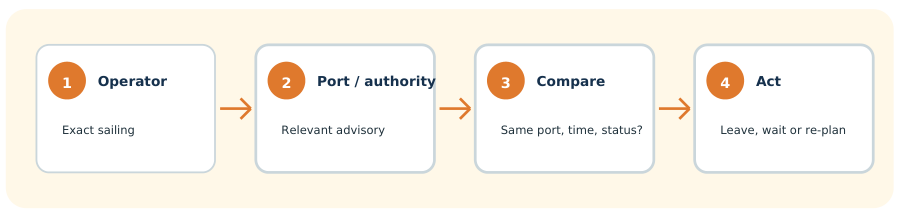
Check the operating company first. Then check the responsible port, terminal or official authority when it publishes a relevant advisory. The PPA website provides official port information, while individual port management offices may publish schedules or local advisories. Not every port uses the same page or update rhythm.
Status log
| When | Source | What it says | Screenshot/reference saved? | Action |
|---|---|---|---|---|
| 24-48 hours before | Operator | Yes / No | ||
| Evening before | Operator or port | Yes / No | ||
| Before leaving accommodation | Operator or port | Yes / No | ||
| At terminal | Official board/counter | Yes / No |
Ask precise questions:
- Is this exact sailing operating?
- Has the departure port or terminal changed?
- Has check-in or boarding time changed?
- Is the vessel/service name different?
- Is revalidation required after a schedule change?
Treat an unverified comment, a forwarded screenshot or another traveller's trip as a lead, not as operating confirmation.
Stop sign: your connection depends on a sailing whose operator cannot confirm the terminal or status.
Check 4 - Read marine weather for the route, not only the destination
Sun at the destination does not describe the water between the ports. Use PAGASA's route-relevant products: the Gale Warning page, the national or regional forecast's coastal-water conditions, and tropical-cyclone bulletins or warnings for shipping when relevant. The High Seas and Offshore Waters Forecast is an additional source only when the route and forecast area make it relevant; it is not the default forecast for every short domestic crossing.
A gale warning is not a personalised go/no-go instruction for your ticket. It is official evidence that sea and wind conditions need attention. The master, operator, port and competent authorities determine whether a particular vessel sails. Never pressure a crew member or ticket seller to ignore a suspension or safety direction.
Weather reading card
| Question | Your answer |
|---|---|
| What waters or seaboard does the route cross? | |
| Is a PAGASA gale warning active for that area? | |
| Is there a tropical-cyclone warning for shipping? | |
| What time was the bulletin issued? | |
| When is the next bulletin expected? | |
| Has the operator issued a route-specific notice? | |
| What is your safe alternative if service stops? |
Recheck close to departure. A saved forecast from yesterday cannot establish today's operating status.
Stop sign: the only weather evidence is a generic phone icon for the destination city.
Check 5 - Confirm check-in, baggage and traveller-specific needs
Conditions differ by operator, route, vessel and fare. Do not transfer an airline baggage assumption to a ferry.
Confirm directly:
- when check-in opens and closes;
- the latest time the operator wants passengers at the terminal;
- whether a printed ticket, QR code or original identification is required;
- number, size and weight of bags;
- charges for excess or special baggage;
- where checked baggage is accepted and collected;
- prohibited or restricted items;
- vehicle check-in, if applicable;
- assistance for limited mobility or other access needs;
- rules for medicines, medical equipment and temperature-sensitive items;
- child, infant and guardian requirements; and
- pet or animal rules, if relevant.
Bag-by-bag plan
| Bag/item | Cabin or checked? | Limit confirmed? | Essential if delayed? | Label/contact added? |
|---|---|---|---|---|
| Identity, ticket, phone | Keep with you | N/A | Yes | N/A |
| Medicines and essential aids | Yes | |||
| Main bag | ||||
| Fragile/special item |
Keep documents, essential medicine, communication tools and one safe payment method with you unless the operator or security rules require otherwise.
Stop sign: staff must decide at the terminal whether an essential mobility aid, medical item or large bag can travel because you did not confirm it earlier.
Check 6 - Separate ferry arrival from your next commitment
An arrival time is not the time you will stand outside the destination port with all bags. Allow for docking, disembarkation, baggage collection, terminal exit and local transport.
For a separate flight, tour, appointment or last bus, record the consequence of missing it. Do not describe two separately purchased services as a protected connection unless the responsible providers expressly confirm that protection.
Connection consequence card
| Next commitment | Scheduled time | Latest useful arrival | Replacement available? | Cash loss if missed | Buffer decision |
|---|---|---|---|---|---|
| Yes / No | PHP |
Prefer an overnight or a large discretionary buffer when:
- the next commitment is expensive or non-refundable;
- the sailing is the last useful service;
- weather exposure is elevated;
- the route has infrequent replacements;
- you are travelling with children, limited mobility or essential equipment; or
- the ferry and onward service are separate purchases.
Use PH-PF-02 for the full task-by-task buffer calculation. This guide's simpler rule is: if failure would end the trip or create a major loss, do not make the planned arrival minute carry the whole risk.
Stop sign: the plan works only if the ferry is exactly on time and you are first off the vessel.
Check 7 - Know what you will do if the sailing changes
MARINA Circular No. 2018-07 sets out passenger rights and operator obligations for cancelled, delayed and uncompleted voyages on covered inter-island passenger liner services. MARINA's own explanation distinguishes rights that apply broadly from remedies whose application depends on the cause of the disruption. For example, its explanation says refund or ticket revalidation applies to cancelled and delayed voyages regardless of cause except when the passenger is at fault, while some amenities or compensation depend on operator responsibility.
Do not convert that summary into a promise about your individual claim. Keep the ticket, operator notice, receipts and written response, and ask the operator which provision applies to the actual event.
Disruption sequence
- Confirm whether the sailing is delayed, cancelled, moved to another terminal or merely under review.
- Ask the operator for the available choice: travel later, revalidate, refund or another stated remedy.
- Protect people first - medicines, food, safe waiting space, children and accessibility.
- Notify the next accommodation or provider before its deadline.
- Price one legal, physically workable alternative before cancelling everything.
- Keep official notices, chat transcripts, receipts and names/times of contacts.
Recovery card
- Current status: ______________________________
- Confirmed by: __________________ at __________
- Ticket choice offered: _______________________
- Earliest usable alternative: _________________
- Safe place to wait or stay: __________________
- Next booking notified: Yes / No
- Evidence saved: Yes / No
Stop sign: you buy a costly replacement because of a rumour before the operating company confirms the original service status.
The seven-check boarding card
Complete this before leaving for the port.
- [ ] 1. Service and place: exact operator, sailing and departure point recorded
- [ ] 2. Ticket and identity: names, accepted identity documents and proof of payment ready
- [ ] 3. Status: operator plus relevant port or authority notice checked
- [ ] 4. Route weather: relevant PAGASA coastal, gale and cyclone products checked
- [ ] 5. Boarding: check-in, baggage and traveller-specific needs confirmed
- [ ] 6. Connection: onward buffer and separate-ticket risk addressed
- [ ] 7. Recovery: contact plan and first fallback written down
Final call
| Result | Meaning | Action |
|---|---|---|
| 7 checks complete | The plan is operationally coherent | Recheck status before departure |
| 5-6 complete | One or two gaps can still break the journey | Resolve them before leaving |
| 0-4 complete | You have a destination idea, not a boarding plan | Do not build a fragile connection around it |
Official source register
Checked 26 October 2026. Reopen current pages close to travel.
-
MARINA - Passenger rights for cancelled, delayed or uncompleted voyages
Official explanation of MARINA Circular No. 2018-07 and the limits attached to different remedies.
https://marina.gov.ph/2019/03/05/marina-to-shipping-operators-uphold-passengers-rights-at-all-times/ -
MARINA Circular No. 2018-07
Source circular on passenger rights and operator obligations for covered inter-island passenger liner services.
https://marina.gov.ph/wp-content/uploads/2018/11/MC-2018-07.pdf -
MARINA - SEAS online ticketing announcement, 11 April 2026
Official announcement on the Ships E-ticketing Application System for domestic passenger ships.
https://marina.gov.ph/2026/04/11/safer-travel-thru-seas-marina-mandates-online-ticketing-system-for-domestic-passenger-ships/ -
MARINA Memorandum Circular No. 180 - passenger manifest rules
Official requirements for passenger counting and manifests.
https://marina.gov.ph/wp-content/uploads/2018/07/mc180.pdf -
PAGASA - Gale Warning
Current official gale-warning status and affected waters when a warning is issued.
https://www.pagasa.dost.gov.ph/marine/gale-warning -
PAGASA - High Seas and Offshore Waters Forecast
Current marine forecast for the responsible forecast area.
https://www.pagasa.dost.gov.ph/marine/high-seas-forecast -
PAGASA - Forecast Weather Conditions
Gateway to current weather and tropical-cyclone products, including warnings for shipping.
https://www.pagasa.dost.gov.ph/weather -
Philippine Ports Authority - official website
Starting point for official port information and links to port management offices.
https://www.ppa.com.ph/ppafrontpage
Reader note
This guide is practical editorial information, not legal advice, a safety certificate or an operating notice. Ferry schedules, ports, terminals, vessel assignments, ticket channels, baggage rules, weather and passenger-remedy procedures can change. Follow instructions from the responsible operator, port and competent authorities for the actual journey.
Philippines Know-How - practical decisions before they become travel problems.